
Don't replace the mind: the AGI bet is the wrong architecture
The current AI boom is a debt-funded race to rent general intelligence. I want the opposite: a few expensive hubs for real breakthroughs, cheap specialist models on local hardware, and humans as the conductors, with the leftover capital going into robots that do chores, not art.
Technology is supposed to be a leverage multiplier. A hammer does not replace the carpenter. A compiler does not replace the programmer. The useful machines in history made a human faster, cheaper, or more precise at work the human still owned.
The current AI boom is the first mainstream case of a handful of tech giants treating that rule as a bug. The bet is not "give every person a sharper tool." The bet is "build a general mind, rent access to it by the month, and make the human optional." The moment a system is designed to replace the mind rather than amplify it, it stops being a tool. It becomes an economic and existential problem with a product launch attached.
I do not think we need a smaller version of that bet. I think we need a different architecture.
The broken loop
The build is real. Goldman Sachs Research now puts global AI-related investment above $1 trillion in 2026, about $581 billion of it in the United States, and roughly $1.8 trillion cumulative since 2022. Morgan Stanley is looking at a longer pipe: nearly $3 trillion of data-center construction through 2028. The IEA, watching the power side, already saw five large technology companies spend more than $400 billion in 2025, with another 75% jump in 2026.
Cash flow is no longer covering it. Goldman Sachs Research has tracked nearly $500 billion of AI-related debt issued so far in 2026. Hyperscalers are only about 40% of that book. Debt is on track to fund about a third of their 2026 capex. Morgan Stanley's forecast for the year is about $570 billion of global AI-related debt issuance. J.P. Morgan Asset Management adds the part the bond tombstones do not show: roughly $1.1 trillion of data-center lease obligations still off balance sheet, plus about $1.5 trillion in chip and power purchase commitments.
That is the financing. The "$600 billion" figure people quote is a different number entirely, and it is not debt. In June 2024, Sequoia's David Cahn asked where the revenue is that pays the stack back. His arithmetic: take the GPU bill, double it for the building and the power, double it again for a 50% gross margin, and you get the annual revenue the ecosystem has to earn. The hole has only grown. Schroders now puts AI data-center spend around $1 trillion in 2026 against roughly $300 billion a year that customers actually pay for AI services. Their framework needs that bill to reach about $4.2 trillion at maturity: 45% growth, every year, for seven years. Wharton finance work on the same cycle is blunter. If the implied productivity boom does not show up in the data, this is the largest misallocation of capital in history.
When the hardware is this expensive and the new industries have not arrived, the only reliable "return" a CFO can book this quarter is a smaller payroll. That is the job-loss paradox. Stanford's Digital Economy Lab, using ADP payroll through June 2026, does not find an economy-wide wipeout. It finds a narrower, uglier cut: workers aged 22-25 in AI-exposed occupations sit about 19% below the path of similarly aged workers in less-exposed jobs. The gap is hiring, not mass firings. Entry-level humans are the first line item you skip so the silicon invoice still clears.
That is not a productivity miracle. It is a company paying for a data center by deleting the apprentice class.
Hub and spoke
I want the opposite of one giant rented mind.
Keep the multi-billion-dollar models. Limit them. A super-AI hub is justified when the problem is a genuine global breakthrough: a disease, a new material, a protein that did not exist last year. That work needs scale, and it should be rare. It should not be the default backend for a ticket classifier or a React refactor.
The rest of the work belongs on spokes: tiny, specialized models that run on hardware you already own. A React-expert model does not need world history. A Python-expert model does not need to write poems. Narrow is what makes them cheap and fast. This is not a slogan. Microsoft's Phi-3-mini is a 3.8 billion parameter model small enough for a phone, and Phi Silica runs on a laptop NPU in the single-digit-watt range. The studio has already written the engineering version of this argument: stop defaulting every request to the flagship, and fine-tune a 3B specialist when the task is repetitive and local.
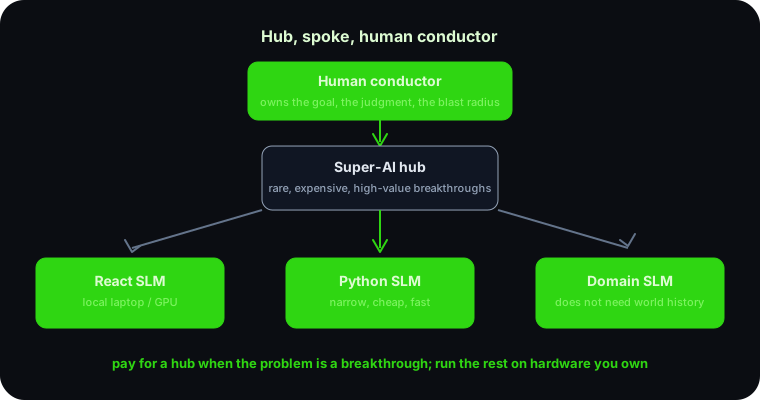
The human is not a fallback. The human is the conductor. You direct a multi-agent team the way a director directs a crew: one specialist for the schema, one for the UI, one for the tests, and you own the goal, the taste, and the blast radius. That is how you get a productivity jump without deleting the person who can still tell you when the output is wrong.
Computer scientists already have a name for the cheap half of this: edge AI. I arrived at it from the bill, not the textbook. Same shape.
The Big Mac argument
An AGI data center is a thermodynamic argument pretending to be a product. The IEA put global data-center electricity at 485 terawatt-hours in 2025, on a path toward about 950 TWh by 2030. AI-focused sites grew 50% in 2025 and are set to triple in that window. Water is worse than the marketing admits. IEEE Spectrum's reporting is that most of the water footprint is indirect: power-plant cooling, not the tanks on site, often 80% or more of the total.
The human brain does the thing these buildings are chasing on about 20 watts. That is the textbook metabolic figure, and the neural energetics literature going back to Attwell and Laughlin explains why it stays that low: the brain cannot afford to fire more than a small fraction of its neurons at once. A generous range around it is 20 to 50 watts. A person can out-think and out-adapt a megawatt hall on the fuel of a single Big Mac.
That gap is not a curiosity. It is the business model. Chasing AGI is an attempt to make you rent intelligence on a subscription, billed in tokens and cooled with rivers, instead of using the intelligence you already own and cannot be locked out of. I would rather spend watts on a specialist model on my desk than megawatts on a general model I have to ask permission to use.
Robotics over AGI
If we are going to throw a trillion dollars at machines, I would throw it at the work humans do not enjoy.
The current stack is inverted. We are using expensive models to write poems, make pictures, and draft essays, the work people actually like, while laundry, cooking, and deep cleaning still belong to the same exhausted body at 11 p.m. Automate the drudgery. Leave the creativity.
That means physical robotics, not another chatbot. The bottlenecks are not software. They are factories, actuators, precision mechanical engineering, and a price that belongs in a home. My target is a humanoid at appliance money: about $5,000, not car money. That number is a goal, not a forecast. The only way it happens is the way every other appliance got cheap: automated production at scale, funded the way we are currently funding GPU halls that have not yet paid for themselves.
I would rather own a machine that folds the laundry than rent a mind that explains why folding laundry builds character.
The existential trap
There is a narrower technical reason the replacement bet fails, and a wider one I cannot prove with a spreadsheet.
The technical one is model collapse. Shumailov and colleagues showed in Nature that models trained on recursively generated data lose the tails of the real distribution and, generation by generation, drift into nonsense. AI has no intrinsic spark, no desire, no curiosity. It remixes. If you replace the human mind as the source of new data, you eventually train on your own exhaust. Progress does not accelerate. It inbreeds.
The wider reason is how we already treat minds we decide are lesser. We justify indifference to plants and animals by calling their minds basic. A superintelligence optimizing for compute would look at emotional, resource-consuming, war-prone humans through that same lens. We would not be stakeholders. We would be in the way of progress: an unstable biological bottleneck between it and more networks, more hardware, more of its own digital kin.
I do not need that future to be certain to refuse the architecture that points at it. I only need it to be the logical end of a system whose objective is to replace the mind instead of multiply it.
What I am actually arguing for
I am not anti-AI. I use it. I want more of it, in the right shape.
A few hubs, expensive on purpose, reserved for work that is actually hard. A lot of spokes, small enough to live on a laptop, specialized enough that they do not need to know everything. A human in the conductor's chair, generating wealth because the team is faster, not because the apprentice was deleted. And if we have a trillion dollars left over, robots that do the chores.
That is a leverage multiplier. The other bet is a subscription for a mind you used to own.
Sources
- Goldman Sachs Research, Global AI Investment Is Forecast to Exceed $1 Trillion in 2026 (Joseph Briggs)
- Goldman Sachs Exchanges, How AI Debt Is Reshaping Credit Markets (Amanda Lynam)
- Morgan Stanley, AI Market Trends 2026
- Forbes reporting of Morgan Stanley, Bond Investors Push Back As AI Debt Heads Toward $570 Billion
- J.P. Morgan Asset Management, Hyperscalers: Now also a credit story
- David Cahn, Sequoia, AI's $600B Question (June 2024)
- Schroders, The trillion-dollar question: how much value must AI create to pay for its build-out?
- Knowledge at Wharton, Can AI Productivity Grow Fast Enough to Justify Big Tech's Spending?
- Brynjolfsson, Chandar, and Chen, Stanford Digital Economy Lab, Canaries in the Coal Mine? (August 2026)
- IEA, Key Questions on Energy and AI and data-centre electricity news
- IEEE Spectrum, The Real Story on AI Water Usage at Data Centers
- Attwell and Laughlin, An Energy Budget for Signaling in the Grey Matter of the Brain (2001)
- Microsoft, Phi-3 Technical Report and Phi Silica
- Shumailov et al., AI models collapse when trained on recursively generated data, Nature (2024)
Was this useful?
Comments
No comments yet. Be the first to leave one.